Spain's paper sector ended 2025 with declines in production, consumption, and revenue, although it increased investment and maintained stable employment. Furthermore, according to the latest comparable data, from 2024, the sector climbed from sixth to fifth place among European paper and cardboard producers and maintained its fifth position in pulp production.
In 2025, the imposition of tariffs by the United States and their indirect effects added a new element of uncertainty for the entire European industry, with a particularly significant impact on the Spanish paper sector. Trade measures and countermeasures altered trade flows throughout the year, in a realignment of the global market that diverted some of the product previously destined for other markets to Spain, to the detriment of Spanish industry and to the benefit of countries with more competitive cost structures.
As Manuel Domínguez, CEO of ASPAPEL , explains : “Our industry competes with energy costs far exceeding those of our neighbors, and against rivals that are no longer just European. Imported paper is gaining ground in Spain and Europe, while our exports are finding it increasingly difficult to break through. Even with this disadvantage, which is beyond our control, the pulp and paper sector continues to invest in sustainability and a circular model based on the bioeconomy.”
Production is declining, but Spain is gaining ground on the European map
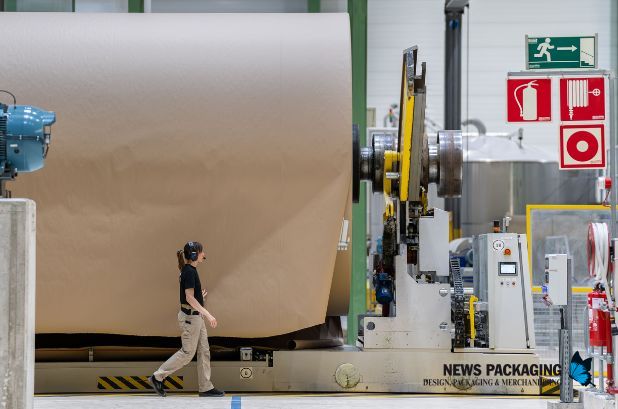
Production in Spain, concentrated in 72 factories—62 paper and cardboard mills, five pulp mills, and five integrated plants—reached 6.306.801 tons, a 3,9% decrease compared to 2024. This decline is more pronounced than the European average, where production fell by 1,6%. According to the latest comparable data from 2024, Spain ranks fifth among European paper and cardboard producers, surpassing France and trailing Germany, Sweden, Italy, and Finland.
Following widespread growth in 2024, paper production fell in 2025 across all categories, with the most significant declines in coated board and other packaging, and in printing paper. Even so, packaging paper remained the leading segment, accounting for 68,9% of total production, driven by the boom in e-commerce and logistics. This was followed by toilet and sanitary paper (14,3%), printing paper (10,3%), and specialty papers and other uses (6,5%).
Meanwhile, pulp production fell by 4,5% to 1.619.690 tons, compared to a more moderate decline of 1,2% for Europe as a whole. According to the latest available data from 2024, Spain remains the fifth largest pulp producer, behind Sweden, Finland, Portugal, and Germany.
Asia gains ground in the Spanish paper market while exports fall
Foreign trade, traditionally the sector's growth engine, was the area most affected by the deteriorating international situation in 2025. Exports of paper and cardboard fell by 5,9%, to 2.586.818 tons – 41% of national production – while imports grew by 1,2%, reaching 2.966.063 tons. As a result, for every 100 tons imported, Spain exported only 87, a lower proportion than the previous year, reflecting the loss of international competitiveness of Spanish factories.
The increase in imports is largely due to the rise of Asia, whose share of non-EU purchases of paper and cardboard increased from 29,3% in 2024 to 33,5% in 2025, reflecting growing competition in the international market. Despite this, Europe remains Spain's main supplier, accounting for 86,4% of imports, and also its main destination, absorbing 64,8% of Spanish paper and cardboard exports.
The pulp sector performed differently, with declines in both exports and imports. Exports reached 921.636 tons, 7,2% less than the previous year. Spain exported 56,9% of its pulp production, primarily to Europe. Imports also fell, by 6,3%, to 1.215.088 tons, with Europe being the main source.
Consumption is holding up better than production
The indicator that held up best in 2025 was consumption, with more moderate declines than those recorded in production.
Paper and cardboard consumption saw a slight decrease of 0,9%, reaching 6.686.046 tons, which translates to a per capita consumption of 126,9 kilograms per person. The category that experienced the sharpest decline was other papers and specialty papers, with a drop of 9,7%.
Cellulose consumption, on the other hand, registered a more pronounced decline of 4,3%, down to 1.913.088 tons.
The paper sector's revenue reached €5.092 billion, 2,7% less than the previous year. According to ASPAPEL, this decline is due, among other factors, to reduced income from paper and cardboard sales and the loss of competitiveness of Spanish factories, penalized once again by high structural and energy costs, exacerbated in 2025 by international trade instability.
Circularity and bioeconomy, competitive advantages for the Spanish paper industry
Despite the complex economic context, the sector maintained its environmental commitments intact, with the circular economy and sustainable forest management as the cornerstones of its production model.
In 2025, the paper collection rate for recycling reached 74,1%, the highest level in the last four years. Spanish paper mills recycled 5.040.015 tons of recovered paper, bringing the recycling rate to 81%. These high collection and recycling levels solidify the Spanish system's position as an international benchmark. Compared to the rest of Europe, the latest available data (2024) maintains Spain's position as the third country with the highest volume of recycled paper, virtually tied with Italy and only behind Germany.
On the other hand, wood consumption stood at 5.308.442 m³ without bark, 4,8% less than in 2024. 89,7% came from domestic eucalyptus and pine harvests, reflecting the sector's strong link with the territory and its commitment to the use of local resources.
Investment grows by 8,9% and leads the push for decarbonization
Far from slowing down investment in this uncertain environment, companies in the sector chose to accelerate it. In 2025, they allocated €318 million to investment, 8,9% more than the previous year, equivalent to 6,3% of annual revenue. Of that figure, €43,6 million was earmarked for decarbonization projects, making the paper industry the manufacturing sector that invests the most in decarbonization relative to its revenue. Quality and the environment accounted for the largest share of the investment effort (22,8%), followed by increased production capacity (21,9%) and technological innovation (18,1%).
The pulp and paper industry maintains its role as an engine of territorial cohesion and stable employment. In 2025, direct jobs stood at 17.581, while indirect jobs remained around 88.000, a balance that ASPAPEL highlights as proof of the sector's resilience.