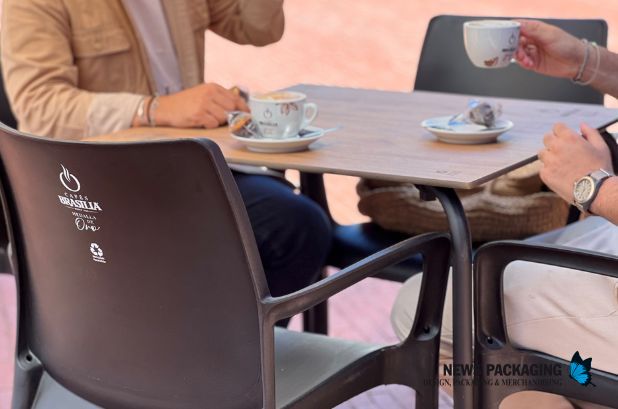
Nestlé , through its HORECA channel division Nestlé Professional, has launched an initiative that converts used coffee capsules and coffee grounds into terrace chairs for bars, cafes and restaurants that are part of its customer network.
The company aims to distribute more than 2.000 chairs as part of this initiative, offering customers four models of functional and minimalist chairs, inspired by four of its most emblematic roasted coffee brands for the restaurant industry: Brasilia Medalla de Oro, which has a wide presence throughout Spain; Nescafé, a global leader in the sector; Santa Cristina Maestría, a very important brand in Malaga; and Bonka, with a large distribution in Catalonia and Levante.
The black Brasilia Medalla de Oro and Nescafé chairs are made with over 220 coffee capsules per chair (40%) and 57% recycled plastic, plus 3% for the color. Meanwhile, the white models designed for the Bonka and Santa Cristina brands are made with 65% recycled plastic and 30% coffee grounds. The remaining 5% is the color.
“ With this initiative, we are taking another step forward and offering our customers functional solutions that, in addition to giving a second life to the plastic from coffee capsules, invite them to be part of the change towards a circular economy ,” explains Hugo Silva, Sustainability Lead at Nestlé Spain . “It’s a doubly positive initiative, as it also helps raise awareness about the importance of recycling among consumers who sit down to enjoy a coffee,” he adds.
“Our commitment to sustainability goes beyond the coffee cup; we seek to ensure that the materials that accompany our brands are also environmentally friendly,” explains Cristina Herraiz, Marketing Manager at Nestlé Professional.
The new furniture has already begun to be installed in bars and restaurants, as well as on the terrace of the company's headquarters in Esplugues de Llobregat (Barcelona). The project was carried out in collaboration with Joluce , a company specializing in plastic recycling, reinforcing Nestlé's commitment to the circular economy. In fact, the amount of virgin plastic in packaging has been reduced by 28% since 2018.